What is the technology?
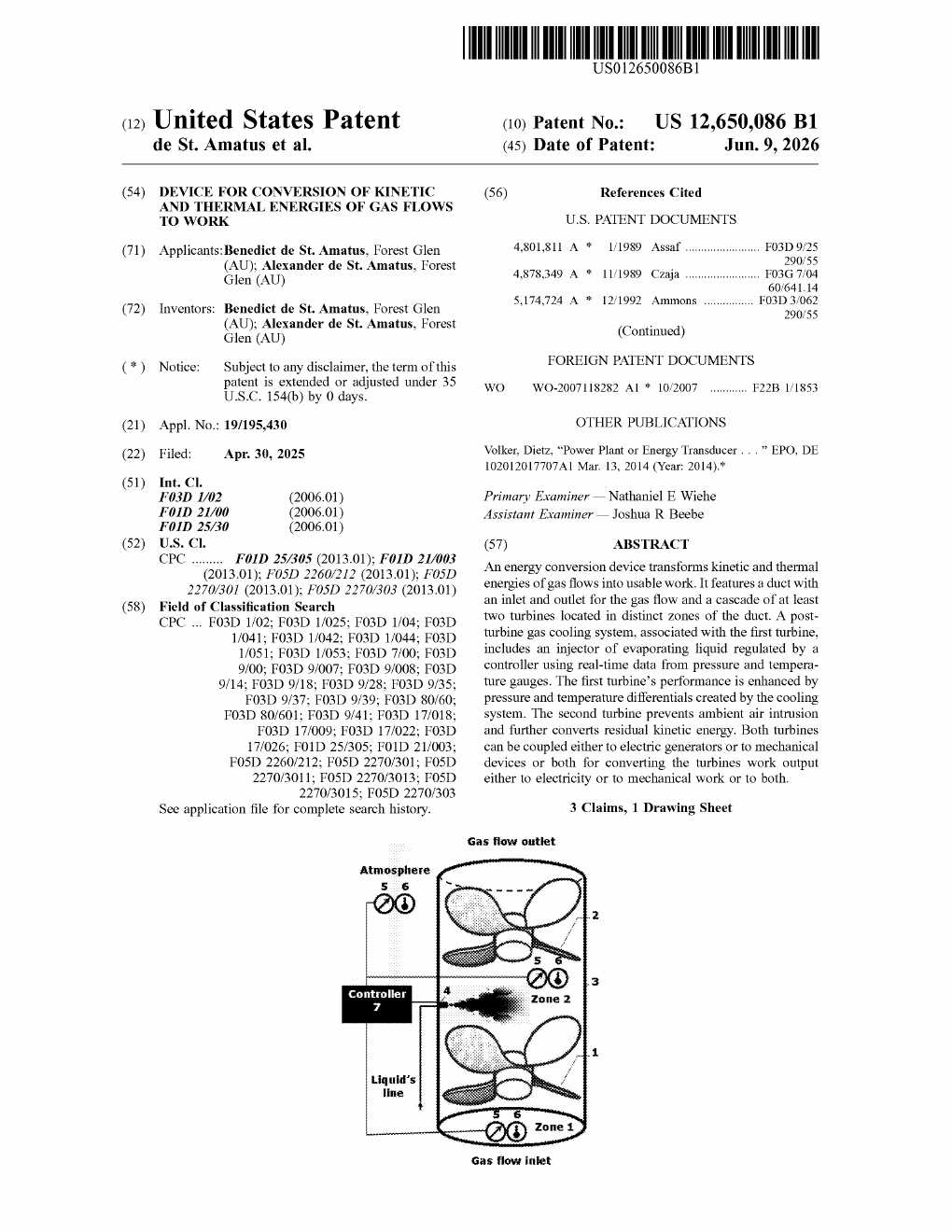
The patented system is a two-stage turbine arranged inside a duct, with controlled evaporative cooling between the two turbines. It is intended to extract useful work from the kinetic, pressure and thermal energy of a suitable moving gas stream.
The central idea is to deliberately lower the pressure and temperature immediately downstream of the first turbine by controlled evaporation, increasing the useful differential across that turbine.
How the system operates
Gas enters the duct
A moving gas stream enters the duct. The first turbine is positioned downstream of the inlet, and the second turbine is positioned further downstream near the outlet to the atmosphere.
The first turbine extracts work
The gas passes through Turbine 1. A fraction of the gas stream's kinetic energy is converted into shaft work, which may be used mechanically or converted into electricity.
Liquid mist is injected immediately downstream
An injector positioned at or near the outlet of Turbine 1 sprays an evaporating liquid into the gas stream.
Evaporation cools the gas
The droplets absorb heat as they evaporate. This is intended to reduce the temperature and pressure in the downstream zone between the turbines.
The larger differential is intended to increase useful work
By lowering the downstream thermodynamic state, the system is intended to increase the pressure and temperature differential across Turbine 1 and thereby enhance its work extraction.
Sensors continuously measure conditions
Pressure and temperature are measured upstream of Turbine 1, in the cooled zone between the turbines, and in the outside atmosphere.
The controller adjusts the injection rate
A controller uses the real-time pressure and temperature measurements to regulate the amount of liquid injected. The intended pressure relationship is that the upstream pressure remains above the interstage pressure, while the interstage pressure remains above atmospheric pressure.
The second turbine manages the outlet and residual energy
Turbine 2 is positioned near the atmospheric outlet. It may recover a further fraction of residual kinetic energy and is configured to oppose ingress of ambient air into the downstream zone.
Useful output may come from one or both turbines
The turbines may be coupled to electrical generators, mechanical equipment, or both. The total useful work may therefore include output from both stages.
Expected advantages
- Potentially greater net energy recovery from suitable industrial gas streams.
- Real-time control of evaporative conditioning rather than a fixed injection rate.
- Potential application to industrial waste-heat and process-gas streams where operating conditions are suitable.
What is being offered?
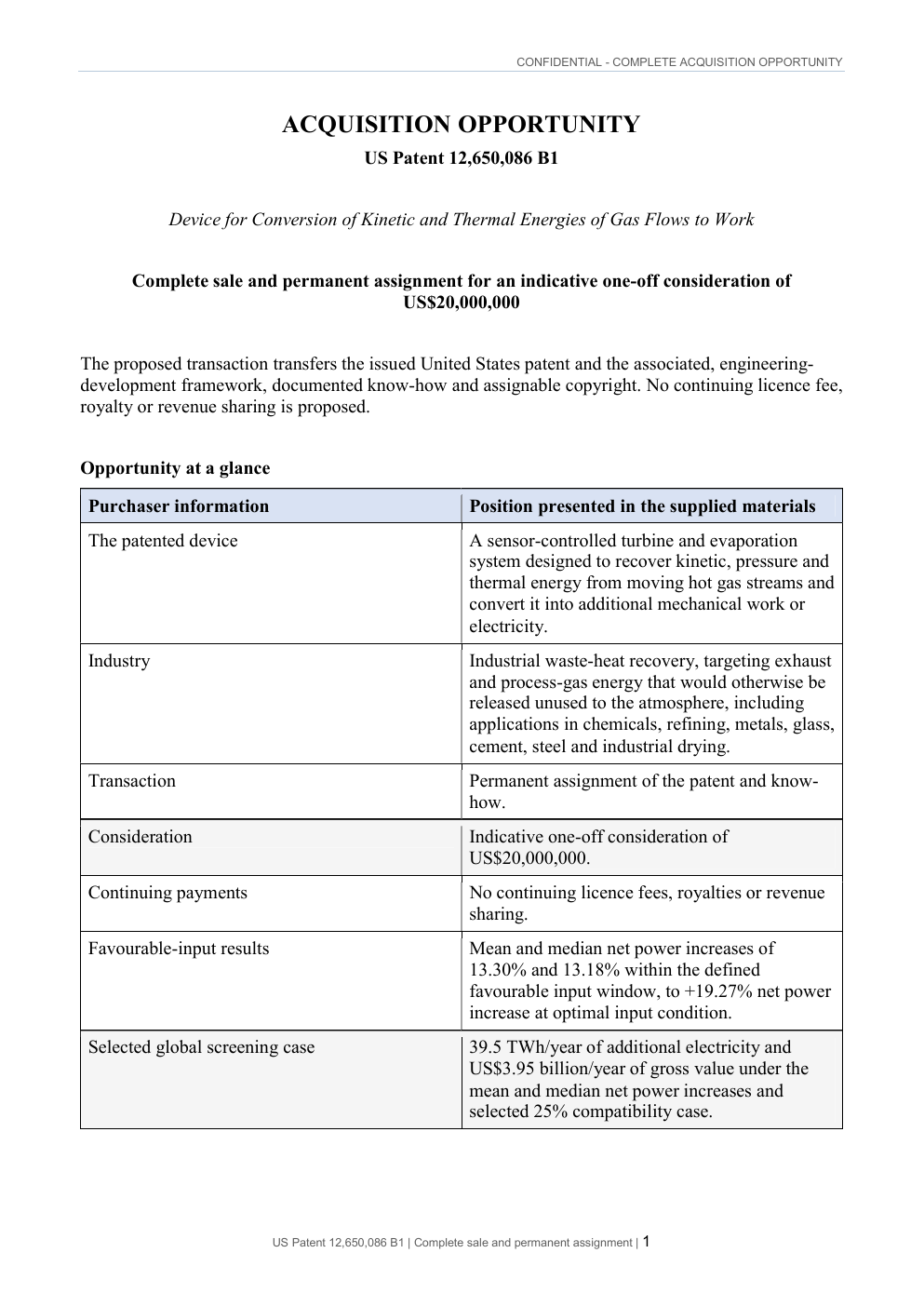
Complete acquisition opportunity: permanent assignment of US Patent 12,650,086 B1 together with the scheduled engineering development framework, technical analysis, browser simulator and source code, data, documented know-how and assignable copyright.
Indicative consideration: US$20,000,000 as a one-off payment. No continuing licence fee, royalty or revenue-sharing payment is proposed.
Documents
Click a front page to open the full PDF.